On 6 November 2025, within the framework of Smart City Expo World Congress, the Interreg Euro-MED Innovative Sustainable Economy (ISE) Mission successfully convened the second edition of the MED Innovation Summit under the theme “ReWeaving Circular Governance in the Mediterranean”. The event brought together innovators, local actors, policymakers and businesses with a shared goal: to explore how circular economy principles and new governance models can transform waste, especially textile waste, into opportunities for sustainable growth across the region.
Shifting the lens: textile waste as regional opportunity
With the Mediterranean facing urgent climate and resource‑use challenges, the Summit placed particular emphasis on textiles, a sector in which Europeans discard around five million tonnes of clothing and footwear annually, yet only about one per cent is recycled into new garments.
“It is very important to promote the impact of the textile sector because it is very heavy in water and land use, waste production and GHG emissions”, Zoi Gaitanarou, Research associate, CERTH (Greece), VerdeinMED representative highlighted.

MED Innovation Summit first panel. Image: Macarena Iglesias
Speakers and participants reflected on how regional collaboration, smart governance and circular economy models can reframe waste not simply as a burden, but as a resource. This aligns with the broader ambitions of the EU’s Strategy for Sustainable and Circular Textiles, which envisions all textile products being circular, climate‑neutral, and free from harmful substances by 2030, a goal that requires coordinated effort from public authorities, businesses, citizens and local communities, particularly in urban areas.
From ambition to action: spotlight on circular governance projects
The Summit’s programme featured two dynamic panels designed to bridge high‑level ambition with on-the-ground realities moderated by Cristina Giner, Journalist and producer at Euronews. The first panel showcased the ISE thematic projects VerdeInMED, REPper, and ProcuraMED that illustrate how entrepreneurial ecosystems, green public procurement, and inclusive governance can scale circular solutions, helping regions to reimagine textile waste and other waste streams as opportunities rather than burdens.
In the second panel, the focus shifted to 2B-BLUE, an ISE thematic project using transformative labs and digital tools to enable cross-sector governance, connecting land‑ and sea-based economies. Through demonstration sites, digital repositories of good practices, and tested governance models, 2B-BLUE highlights how systemic innovation can deliver tangible, long-term impact across different economies and geographies.
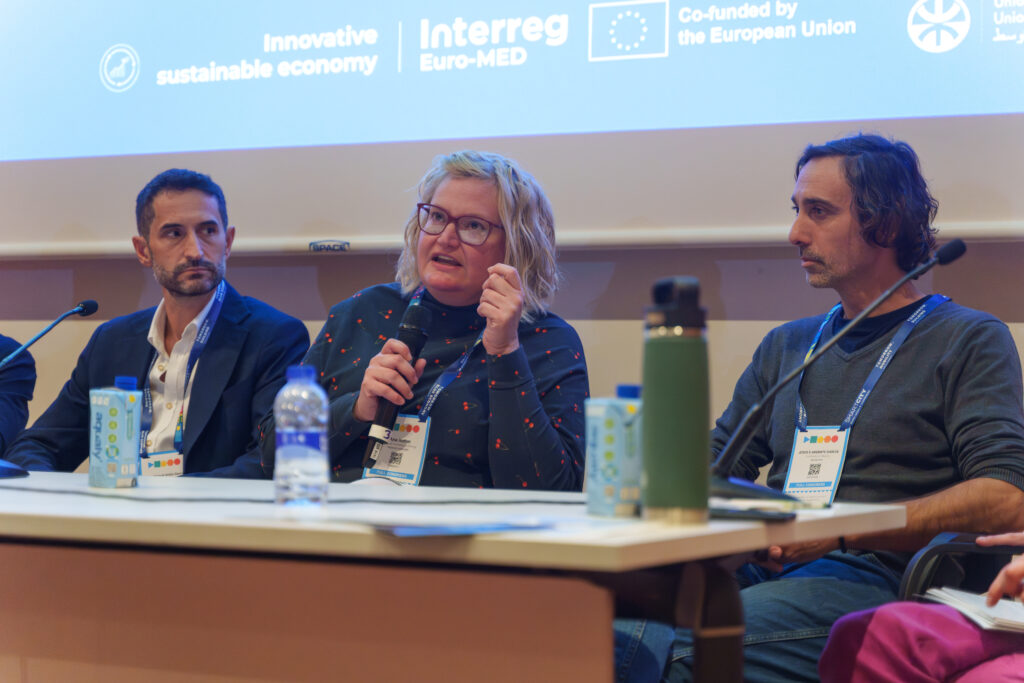
MED Innovation Summit second panel. Image: Macarena Iglesias
During the discussions, participants stressed the need for multi-stakeholder collaboration, from local governments to SMEs, researchers and civil society, to ensure that circular economy solutions are inclusive, scalable, and deeply embedded in regional planning.
Engaging community, policy, and economy: all in one summit
The event was designed as an interactive space: moderated discussions, case-study presentations and active audience engagement allowed for a diversity of voices to participate. By contributing to Smart City Expo’s Governance & Economy track, the Summit merged the worlds of innovation, sustainability, and city-level governance.

Audience engagement during the MED Innovation Summit. Image: Macarena Iglesias
Moreover, by holding the Summit during the Smart City Expo, registered participants had access not only to the session itself but also to the full Congress programme, including exhibitions, breakout sessions, and other networking opportunities, strengthening connections between Mediterranean stakeholders and global smart-city actors.
A stepping-stone for a circular Mediterranean future
The “ReWeaving Circular Governance” session did more than showcase ideas: it underscored that a circular, resilient and sustainable Mediterranean economy is achievable through cooperation, smart governance, and a shift in mindset. Through collaborative initiatives like the ISE Mission thematic projects, the path toward circular textiles and resource-efficient urban economies is becoming clearer.
The Summit affirmed that turning waste into opportunity, especially in sectors like textiles, requires coordinated effort across governance levels. As such, this event stands out as a milestone in advancing circular economy principles in the Mediterranean: a concrete and action-oriented step toward the region’s sustainable future.