Interview to Francesco Camonita, Coordinator of Pillar Connect
The Innovative Sustainable Economy Community (ISEC) Hub was created to bring together the Mediterranean’s brightest innovators, fostering collaboration and driving sustainable transformation across the region. In this context, the Pillar Connect plays a key role, building bridges between actors, initiatives and projects to promote transnational collaboration and the exchange of knowledge and expertise. To gain a better understanding of this Pillar’s vision and work, we spoke to Francesco Camonita, the Pillar’s Coordinator.
Francesco Camonita is Policy and Project Officer at the Conference of Pheripheral Maritime Regions (CPMR) – Intermediterranean Commission, Partner of Dialogue4Innovation.Francesco Camonita is Policy and Project Officer at the CPMR – Intermediterranean Commission, a partner of Dialogue4Innovation. He is Work Package Leader of WP3 – Coordination, which works to build lasting institutional and social dialogue and to connect the transnational dimension with local solutions.
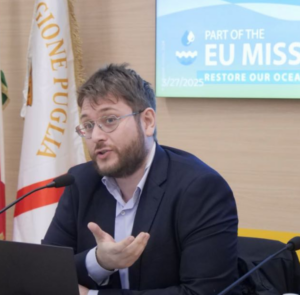
Thank you for joining us today, Francesco. We would like to begin this interview with a general reflection. The concept of ‘connection’ is central to Euro-Mediterranean cooperation, particularly given the fragmentation among the various actors and initiatives operating in the region. According to you, what does it mean in practice to connect Mediterranean innovators, and what are the main challenges related to this issue?
Thank you very much for having me! In my opinion, connecting Mediterranean innovators means something far deeper than putting names into a list or inviting people to a conference. It is about creating a living ecosystem of organisations and individuals who share a common ambition: driving a fair and innovative transition toward a sustainable economy in our region. The Mediterranean is a fascinating place—so rich in talent, ideas, and cultural diversity, yet often fragmented by administrative borders, funding silos, and the simple fact that many brilliant people working on the same challenge do not know each other or are stuck to the rules of their own funding schemes.
In practice, connecting innovators means transforming a traditional, one-way stakeholder database into a space where people talk to each other, not only to the programme. It means building bridges across our quadruple helix—public authorities, businesses, researchers, and civil society—so that policy evolves with real needs and innovation responds to real-world challenges. It means empowering Southern and Eastern Mediterranean voices as much as Northern ones, because the ecological and economic transition will succeed only if it is genuinely regional.
The challenges are real: language barriers, different levels of digital maturity, uneven access to funding, and sometimes a lack of trust between sectors or countries. But I see this not as a limitation, rather as the very reason why the ISEC Hub exists. Our work is to transform fragmentation into constellation—many points of light that, once connected, form a direction of travel for our shared future.
The Pillar Connect uses digital tools, such as the LinkedIn Group and the Dynamic Hub Directory on Kumu. What advantages does this approach offer over traditional networking and stakeholder mapping methods?
I personally see that traditional networking tools often behave like static drawers: you can store contacts in them, but they do not breathe. A closed Excel sheet or stakeholder list tends to travel in one direction—from the project to the audience—and once it is created, it rarely evolves. With the Connect Pillar, we wanted to break that pattern entirely.
The LinkedIn Group creates a horizontal space where content flows in both directions. Unlike the institutional LinkedIn page of the ISE Mission, here all ISEC Hub Members can promote their projects, ask for partners, share events, suggest topics for MED Innovation Camps or MED Innovation Summit, and even co-design activities. It removes the distance between the programme and the community and encourages interaction at any time—not only during official meetings.
The Kumu Dynamic Directory is, in my view, the real spark of originality in something not observed in other stakeholder hubs. Instead of showing a flat list, it visualises relationships, thematic fields, geographical clusters, and potential synergies. You can search, filter, and explore who is working on circular tourism, blue biotechnology, green finance, sustainable ports, food system transition, and much more. It allows members to find collaborators they did not know they needed. And because it is dynamic, it grows and adapts with the Hub, holding a great potential for network visualization to external audiences! In short, these digital tools transform networking into a living process that makes Mediterranean cooperation continuous, discoverable, and hopefully inspiring.
In short, these digital tools transform networking into a living process that makes Mediterranean cooperation continuous, discoverable, and hopefully inspiring.
Imagine you could speak directly to ISEC Hub members right now. What advice would you give them to make the most of the tools offered by Connect? And how could members translate the contacts they have made into opportunities for collaboration?
My advice is simple: don’t be a stranger or a silent passenger! The ISEC Hub is not a library to consult occasionally, it is a community to shape. So I encourage every member to complete their Kumu profile in a rich and meaningful way—highlighting their expertise, interests, needs, and the specific thematic areas they want to contribute to. The more precise the information, the easier it becomes for others to find you and say: “We should work together.”
Then, please participate actively in the LinkedIn Group (and we really need your help for this!). Share a call for partners, ask for a speaker for an event, post an article, offer a mentoring exchange, or even start a conversation about something that keeps you curious or the sharing of an inspirational LinkedIn video. Every interaction reinforces the Mediterranean innovation fabric.
Collaboration does not always start with a big project. Sometimes, it begins with a quick conversation and a shared sense of purpose. If we approach the Hub with generosity—offering as much as we request—we accelerate the transition for all by doing our own very small part.
Looking ahead to two years’ from now, how would you like to see the ISEC Hub community evolve?
That seems like a long time, but then again I have almost been in this project for two years already! Well, when I look into the future, I imagine a community that is not only larger, but truly self-driven. A Hub where members are not waiting for announcements but initiating working groups, shaping Mediterranean policy messages together, and building cross-border alliances on blue economy, circular value chains and much more! A place where a public authority in Tunisia learns from a circular textiles project in Spain, or a Greek university co-designs a clean energy pilot with an Italian SME.
I would love to see the Hub become a reference for anyone in the Mediterranean who works on innovative and sustainable economic transition. A space recognised for its capacity to connect solutions with territories, and territories with each other.
Success for the hub would likely mean creating partnerships that did not exist before the Hub now delivering concrete results. Or maybe new opportunities for capitalisation and replication of good practices beyond borders. In terms of institutional dialogue, we would-love to see community-surveyed policy contributions and a sense of belonging among hundreds of innovators who feel that they are building the future of the Mediterranean—together. Thankfully, Governance4Innovation will last until 2029 and we have plenty of time to make these dreams come true!