The Mediterranean is facing growing environmental and social pressure. Climate change, rising living costs, water scarcity, territorial inequalities and economic uncertainty
are all shaping the future of the region. At the same time, Europe is pushing forward with the transition towards a circular economy, a model that aims to reduce waste, extend the life of materials and products and make better use of resources.
But there is an important question behind this transition: who benefits from it and who risks being left behind?
A new policy paper developed within the Interreg Euro MED Innovative Sustainable Economy (ISE) Mission explores how circular economy policies can become more inclusive, fair and territorially balanced through a Just Transition approach. The paper analyses experiences from several thematic projects across the Mediterranean and identifies ways to ensure that environmental progress also strengthens social cohesion and local resilience.
Why a Just Transition matters
The circular economy is often discussed in terms of technology, innovation and competitiveness. However, the transition also has major social and territorial implications. Different regions and communities have different starting points, economic structures and capacities to adapt. The Mediterranean is a clear example of this complexity.
The region is warming around 20% faster than the global average, while many rural, coastal and island territories already face economic and social vulnerabilities.
In some parts of Southern Europe, poverty risks remain high and access to opportunities is uneven. The policy paper highlights that environmental policies cannot succeed in isolation from social realities. A circular transition must therefore be designed in a way that:
- supports local economies,
- creates decent jobs,
- reduces inequalities,
- strengthens territorial cohesion,
- and includes communities in decision-making processes.
In short, the transition should not only be green, it should also be fair.
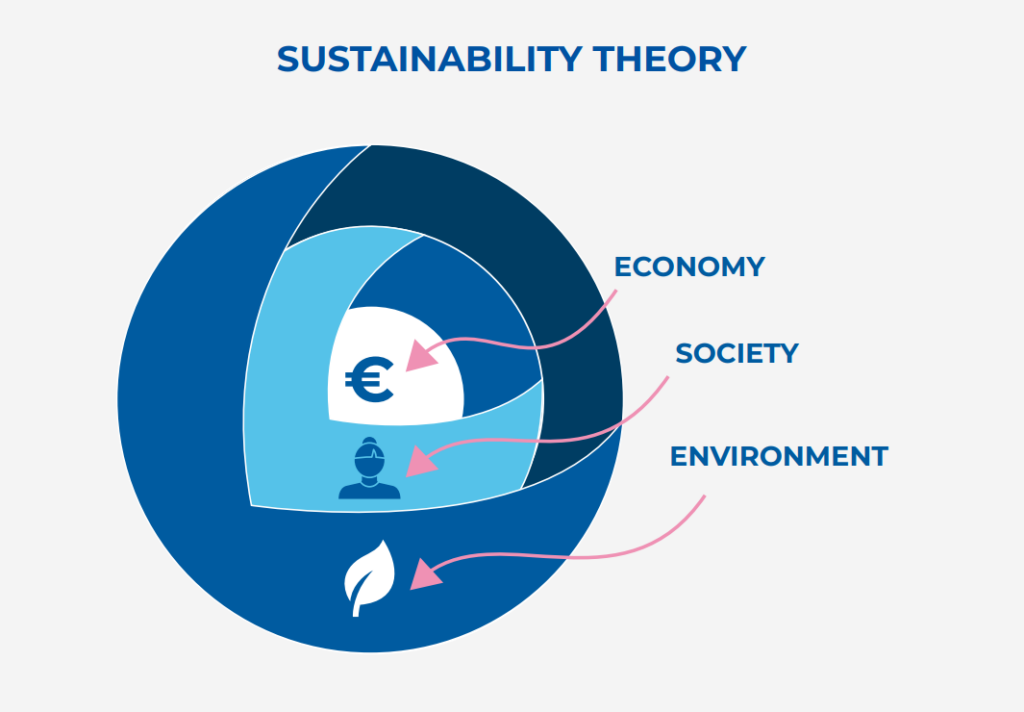
Figure 1. MedWaves, 2016. Sustainability theory
What the paper analysed
The study examined eight thematic projects from the Interreg Euro MED ISE Mission through the lens of Just Transition principles. While many projects did not explicitly frame their work around “Just Transition” the analysis showed that several of them are already applying these principles in practice.
The paper focused on four main dimensions:
1-) Inclusive governance and participation
Many projects moved beyond traditional consultation models and adopted participatory approaches involving public authorities, researchers, businesses, civil society organisations and local communities.
Projects such as AZA4ICE, BLUE ECOSYSTEM and AquaBioNets developed collaborative ecosystems where stakeholders jointly identify challenges and co-design solutions. This type of multi actor governance helps ensure that local realities and community knowledge are integrated into the transition process. The analysis also showed that local authorities often play a central role, not only as supporters but as active co-creators of long-term strategies.
2-) Social cohesion and intersectionality
The projects also demonstrated growing awareness that different social groups experience environmental and economic transitions differently. Several initiatives included measures targeting young people, rural communities, small businesses and vulnerable groups.
REPper, for example, combined repair culture with youth reskilling initiatives, while REVIVE focused on strengthening rural economies and countering depopulation through community-based cooperation. The paper notes, however, that intersectionality, considering how factors such as gender, age, income level, migration background or territorial vulnerability overlap, is still not systematically integrated into project design and monitoring.
3-) Territorial cohesion
One of the strongest findings of the paper is that place-based solutions matter. The Mediterranean is not a single homogeneous territory. Coastal regions, islands, rural communities and urban areas all face different challenges and opportunities. Several projects adapted their approaches to local conditions rather than applying one-size-fits-all models.
Projects such as Carbon Farming MED and REVIVE highlighted how local economic structures, land ownership patterns and regional capacities directly influence the success of green transitions.
The paper stresses that territorial cohesion should remain central to future circular economy policies, particularly in regions with lower institutional or financial capacity.
4-) Capacity-building, reskilling and job creation
Training and skills development emerged as one of the most embedded dimensions across the analysed projects.
Many initiatives included:
- vocational training,
- mentoring schemes,
- digital skills support,
- technical guidance for SMEs,
- and educational activities for younger generations.
Projects like VERDEinMED and REPper demonstrated how circular economy initiatives can support employability while helping businesses and workers adapt to new market conditions.
The paper also underlines the importance of anticipating future labour-market changes and strengthening local capacities before economic disruptions occur.
Key policy recommendations
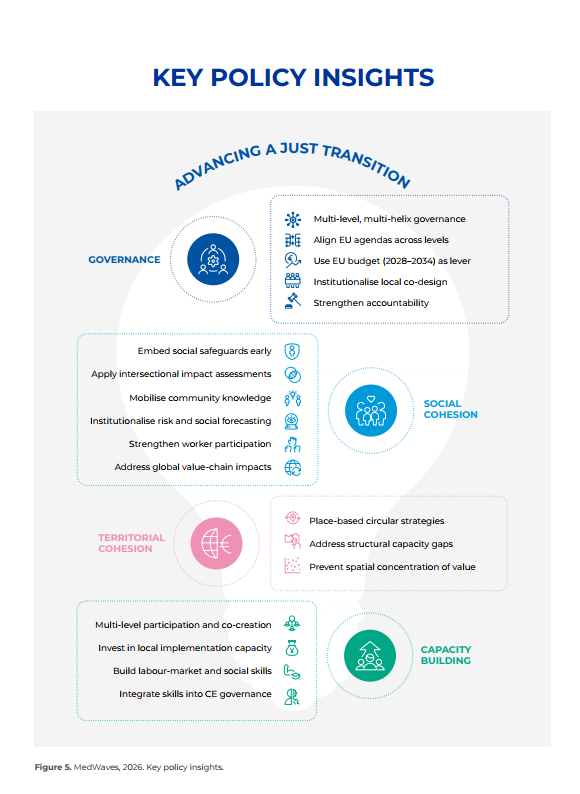
Based on the findings, the paper proposes several recommendations to strengthen the social dimension of the circular transition in Europe and the Mediterranean.
Among the key recommendations are:
- embedding social safeguards into circular economy policies from the beginning,
- strengthening multi-level and participatory governance,
- improving coordination between EU funding instruments and policy frameworks,
- supporting rural, coastal and less-developed territories,
- investing in local skills and administrative capacities,
- and introducing stronger social and territorial impact assessments.
The paper also calls for better alignment between environmental goals and cohesion policy, ensuring that green investments contribute to reducing inequalities rather than reinforcing them.